


Most collectors search eBay the same way.
They type in a player name, add a parallel, then narrow it down until only the “right” cards appear.
It feels smart. It feels efficient.
And it quietly puts you in the most expensive part of the market.
The best deals I find rarely come from knowing exactly what to search for.
They come from searching wider than everyone else is comfortable with.
Disclosure: Some links in this post are affiliate links. If you click and buy, I may earn a small commission at no extra cost to you.
Disclaimer: This is not financial or investment advice. I am sharing what I am seeing as a collector and how I approach the hobby. Always do your own research and collect based on your goals. Past performance does not guarantee future results. All purchases you make are your own decisions, and The Collectors Edge is not responsible for gains or losses that result from your collecting choices.
In this week’s Collectors Corner, I am going to show you how intentionally broad eBay searches uncover mislisted cards, underpriced auctions, and value opportunities that never appear when you search too precisely.
This is not about predicting breakouts or chasing hype.
It is about operating in parts of the market where mistakes still exist and letting patience do the work.
If you are trying to build a collection while funding the hobby along the way, this single habit can quietly change how often you find value.
Why Being Too Specific Can Cost You Deals
The more specific your search, the more efficient you are at finding known cards.
But sometimes that efficiency hides the cards that are undervalued.
When you always search for exact players, parallels, or card names, you are competing in the most efficient part of the market, where prices tend to be sharper because everyone else knows exactly what they are looking as well.
Instead of relying only on specific searches, add a few generic saved searches to your routine.
Generic searches work because mislistings live there. Newer sellers live there. Busy sellers live there. And those listings are far more likely to be underpriced.
If a seller does not fully understand the set, the parallel, or the short print they own, they usually describe it in the simplest terms possible.
That is where value collectors win.
Starting Wide on Purpose
The key is not what you search for. It is how wide you start.
When I run a generic eBay search, I am not anchored to an exact card. The goal is to stay broad enough that mistakes still exist.
That wide starting point creates room for mislabeling, confusion, and shortcuts taken by sellers. That is where opportunity shows up.
One example of how I do this is with a search like:
Mosaic football cards
If I am targeting a specific rookie or a year with a strong gem rate, I will add the year. Otherwise, I keep it wide and let the market show me what is available.
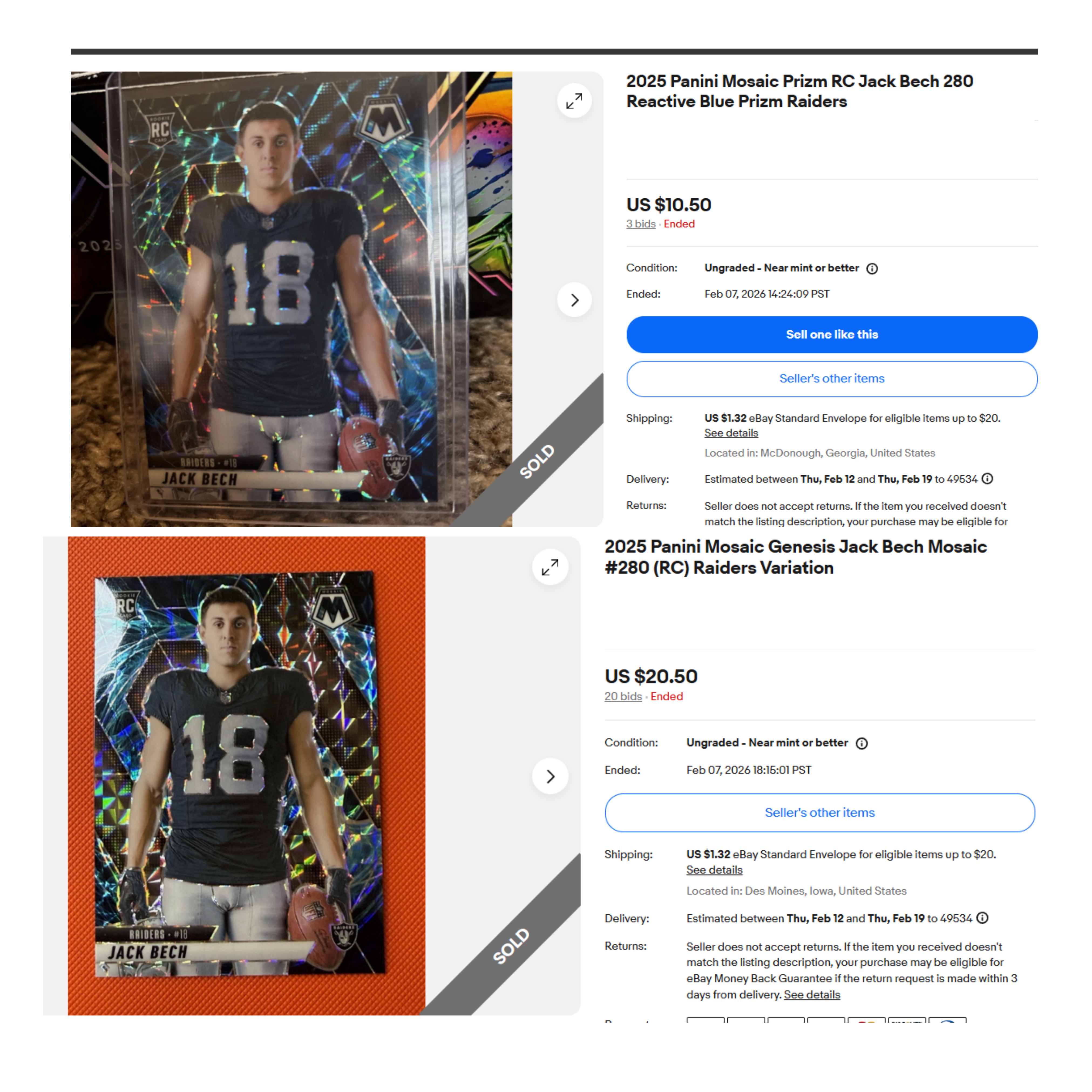
Mosaic is a good example because it is loaded with short prints and case hits that get mislabeled constantly. Genesis. Honeycomb. Peacock. It is not uncommon to see a Genesis listed as a blue reactive simply because the seller does not know the difference.
Those mistakes are opportunities.
Once the search is set, I let filters do the work.
Quick tip: Before running any generic search, pull up the set checklist. Spend a few minutes learning what the short prints and case hits actually look like. That small amount of prep makes it much easier to spot cards others scroll past.
Let Filters Do the Heavy Lifting
Once the search is set, filters matter more than how fast you scroll.
I start by switching to auctions only. Fixed-price listings usually reflect market awareness. Auctions, especially poorly timed ones, leave room for value to surface naturally.
Timing matters more than most collectors realize. I look for auctions ending mid-day or during the workweek. Weekend nights attract more eyes, and more eyes push prices higher. I want the opposite environment, where attention is lower and patience gets rewarded.
From there, I open the advanced settings and require a minimum of one bid. This removes listings that start at inflated prices and forces the seller to let the market participate honestly.
If grading is part of the plan, I filter out graded cards. Raw cards still leave room for upside. Graded cards usually price that upside in already.
With these filters in place, scrolling becomes intentional instead of overwhelming.
Spotting the Mislabeled Card
Now comes the fun part.
As I scroll, I am not just looking for players. I am watching for familiar designs, patterns, and anything that looks slightly off or mislabeled.
If something catches my eye and I am unsure, I pause and check the checklist. Two minutes of research can turn into a very profitable habit.
One of my favorite examples was a card I bought for $20 that later sold for $50.


The listing title called it a Bo Nix Blue Scope Preview.
But on the back of the card, the set clearly said Donruss Optic.
It was not a preview.
The seller did not know the difference.
The market does.
Verifying Value Before You Bid
Once a card passes the eye test, I do not guess.
I take it to Market Movers and check recent sales. Raw comps. PSA 10 comps. That tells me two things quickly.
What the card actually sells for'.
Does grading makes sense.
If the numbers work, I bid with confidence.
If they do not, I move on.
I use 130point.com for recent comps and Market Movers to track longer-term price behavior. Market Movers offers a 14-day free trial and 20% off through my link below.
Build the Habit, Not the Highlight Reel
You will not find underpriced cards every session. That is normal.
What matters is repetition. Set aside time every few days. Run the same searches. Train your eye. Over time, patterns jump out faster and decisions feel easier.
This is how new collectors build skill without gambling on hype. And over time, that skill compounds.
A Few Searches I Keep Saved
These are examples of generic searches I run regularly. Feel free to use them, adjust them, or treat them as a starting point.
What matters most is finding searches that match your eye and your comfort level.
Over time, certain sets, designs, and listing styles will start to stand out to you faster than others.
That is when this approach really starts to pay off.
Why This Works Over Time
This approach will not produce instant wins.
That is the point.
Over time, your eye gets sharper. Your patience improves. Your confidence grows.
You stop guessing and start recognizing value.
That is how collectors fund the hobby without chasing hype.
If you want more Collectors Corner breakdowns like this, along with Card Market Pulse updates and deeper Profit Playbook strategy, consider subscribing to The Collectors Edge.
This is where collecting gets clearer, calmer, and more intentional.
- Mr. Collect


Thanks for the article. I love the strategy here and already apply much of what was suggested. My question is if I bid on a card well under value, will I still be able to get the market value for that card? Will a buyer expect to pay the lower price? I often think about that when buying to flip on eBay.